
16 Ene Gut microbiota fingerprinting as a potential tool for tracing the geographical origin of farmed mussels (Mytilus galloprovincialis)
Identificar la procedencia de los productos del mar es fundamental para combatir el fraude comercial, hacer cumplir las normas de seguridad alimentaria y garantizar la confianza de los consumidores. El presente estudio nos ha permitido determinar que la composición bacteriana, presente en la glándula digestiva y el estómago de los mejillones M. galloprovincialis, puede usarse como herramienta de trazabilidad para discriminar el origen geográfico. Para llegar a esta conclusión se caracterizó, mediante la secuenciación de un fragmento del ARNr 16S, la microbiota de 160 mejillones muestreados en 2019 a partir de cinco granjas de mejillones diferentes ubicadas en tres regiones de España (Galicia, País Vasco y Cataluña) y en diferentes estaciones. Este enfoque metodológico nos va a permitir rastrear el origen geográfico de los mejillones no procesados y podría tener usos potenciales en la trazabilidad de los productos del mar y la seguridad alimentaria.
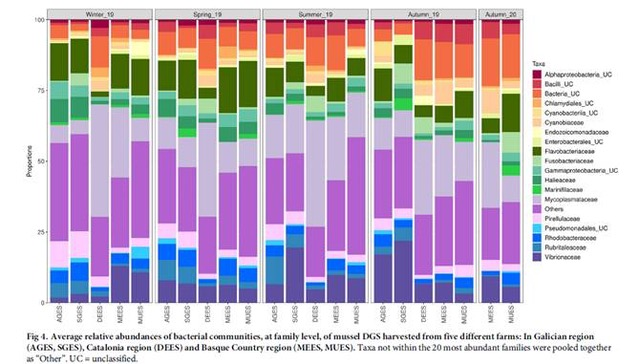
Identifying the provenance of seafood is critical to combat commercial fraud, enforce food safety regulations and ensure consumers’ confidence. Hence, the current study aimed to determine if the bacterial composition present in the digestive gland and stomach of M. galloprovincialis mussels could be used as traceability approach to discriminate their geographic origin. The microbiota of 160 mussels collected seasonally in 2019 from five different mussel farms located in three regions in Spain (Galicia, Basque Country and Catalonia) was characterized using 16S rRNA targeted amplicon sequencing. Results showed that the bacterial community composition/fingerprint was significantly different between harvesting locations and seasons, with the effect prompted by the origin exceeding the seasonal variability. To further evaluate the stability and potential of this traceability approach, the bacterial fingerprint of 20 new individuals collected from the Basque Country in autumn 2020 were compared to the profiles obtained in 2019. Results showed that mussels collected from the Basque Country in two consecutive years cluster together, even matching the season of harvesting. The findings of this preliminary study support that this methodological approach has the potential to trace the geographical origin of unprocessed mussels and could have potential uses in seafood traceability and food safety.
No Comments